imucal.FerrarisCalibration#
- class imucal.FerrarisCalibration(grav: float = 9.81, expected_angle: float = -360, calibration_info_class: type[~imucal.ferraris_calibration_info.FerrarisCalibrationInfo] = <class 'imucal.ferraris_calibration_info.FerrarisCalibrationInfo'>)[source]#
Calculate a Ferraris calibration matrices based on a set of calibration movements.
The Ferraris calibration is derived based on a well defined series of data recordings:
Static Holds
Name
Explanation
x_ppositive x-axis of sensor is aligned with gravity (x-acc measures +1g)
x_anegative x-axis of sensor is aligned with gravity (x-acc measures -1g)
y_ppositive y-axis of sensor is aligned with gravity (y-acc measures +1g)
y_anegative y-axis of sensor is aligned with gravity (y-acc measures -1g)
z_ppositive z-axis of sensor is aligned with gravity (z-acc measures +1g)
z_anegative z-axis of sensor is aligned with gravity (z-acc measures -1g)
Rotations
Name
Explanation
x_rotsensor is rotated clockwise in the
x_pposition around the x-axis (x-gyro shows negative values) for a well known angle (typically 360 deg)y_rotsensor is rotated clockwise in the
y_pposition around the y-axis (y-gyro shows negative values) for a well known angle (typically 360 deg)z_rotsensor is rotated clockwise in the
z_pposition around the z-axis (z-gyro shows negative values) for a well known angle (typically 360 deg)All sections need to be recorded for a sensor and then annotated. This class then takes the data of each section (represented as a
FerrarisSignalRegionsobject) and calculates the calibration matrizes for the gyroscope and accelerometer.As it is quite tedious to obtain the data of each section in a seperate array, you should make use of the available helper functions to turn a continous recording into annotated sections (See the See also section)
- Parameters:
- sampling_rate
Sampling rate of the data
- expected_angle
expected rotation angle for the gyroscope rotation.
- grav
The expected value of the gravitational acceleration.
- calibration_info_class
The calibration Info class to use to store the final calibration information. This should be a FerrarisCalibrationInfo or a custom subclass.
See also
imucal.ferraris_regions_from_dfGenerate valid sections from preannotated dataframe.
imucal.ferraris_regions_from_interactive_plotGenerate valid sections via manual annotation in an interactive GUI.
imucal.ferraris_regions_from_section_listGenerate valid sections based on raw data and start-end labels for the individual sections.
Notes
Depending on how the axis of your respective sensor coordinate system are defined and how you perform the calibration, you might need to change the
gravandexpected_angleparameter.Typical situations are:
If you define the positive axis direction as the direction, where the acc measures -g, change
gravto -9.81 m/s^2If you perform a counter-clockwise rotation during the calibration, set
expected_angleto +360For combinations of both, both parameter might need to be adapted
Examples
>>> from imucal import FerrarisCalibration, ferraris_regions_from_interactive_plot
>>> sampling_rate = 100  # Hz
>>> data = ...  # my data as 6 col pandas dataframe
>>> # This will open an interactive plot, where you can select the start and the stop sample of each region
>>> section_data, section_list = ferraris_regions_from_interactive_plot(
...     data, sampling_rate=sampling_rate
... )
>>> section_list.to_csv(
...     "./calibration_sections.csv"
... )  # Store the annotated section list as reference for the
... # future
>>> cal = FerrarisCalibration()  # Create new calibration object
>>> calibration_info = cal.compute(  # Calculate the actual matrizes.
...     section_data,
...     sampling_rate_hz=sampling_rate,
...     from_acc_unit="a.u.",
...     from_gyr_unit="a.u.",
...     comment="my custom comment."
...)
>>> calibration_info_class
< FerrarisCalibration object at ... >
Methods
compute(signal_regions, sampling_rate_hz, ...)Compute the calibration Information.
- __init__(grav: float = 9.81, expected_angle: float = -360, calibration_info_class: type[~imucal.ferraris_calibration_info.FerrarisCalibrationInfo] = <class 'imucal.ferraris_calibration_info.FerrarisCalibrationInfo'>) None[source]#
- compute(signal_regions: FerrarisSignalRegions, sampling_rate_hz: float, from_acc_unit: str, from_gyr_unit: str, **kwargs) CalibrationInfo[source]#
Compute the calibration Information.
This actually performs the Ferraris calibration following the original publication equation by equation.
Examples using imucal.FerrarisCalibration#

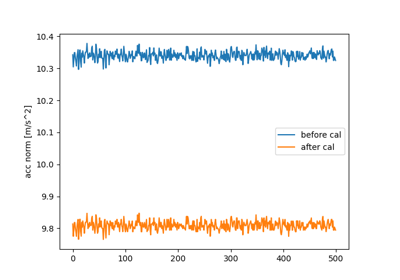
Annotate a session and perform a Ferraris Calibration